
Description/Diagram of the Musical Coordinate Plane and Labeling
We usually refer to the musical coordinate plane as Music Notation. Musicians use written "notes" to decide what to play or sing. Each note has an "x" value and a "y" value - just like in the mathematical coordinate plane. Music notation begins with a system of five lines with four spaces between. It is called a staff. Each line and space has a letter name:
You may notice that some of the letter names are low and some are high. This the y-axis of the musical coordinate plane or as we call it in music: pitch.
The y-axis or pitch in the musical coordinate plane is fairly easy to understand. Just like in the mathematical coordinate plane some "coordinates" are high and some are low.
The x-axis is a little trickier. As mentioned on the previous page the x-axis in the musical coordinate plane is called duration which is a measurment of time. And, as mentioned, musicians measure duration in "beats." To determine how many "beats" a note has musicians developed a system:
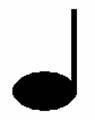 |
This is known as a "quarter" note. It is a basic measurment of time in musical notation and has a duration of one beat.
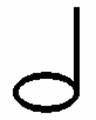 |
This is known as a "half" note. It has a duration of two beats. (That also means it lasts twice as long as a "quarter" note!)
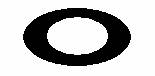 |
This is known as a "whole" note. It has a duration of four beats. (That also means it lasts four times as long as a "quarter" note and twice as long as a "half" note!)
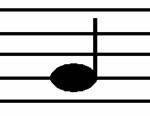
Just like ordered pairs in the mathematical coordinate plane, musical notes should always be refered to by their ordered pair name. For example, if there is a quarter note written on the staff on a pitch with the letter name g, the proper way to identify the note in the ordered pair format would be: (quarter, g). If asked, you could say aloud, "a quarter note on g." (Just like the mathematical coordinate plane, the format is always: (x,y) with the "x" value listed first.)
To go on to the Examples of "Ordered Pairs" on the Musical Coordinate Plane click here